Queen: The Universal Compromise
The Queen mattress (60 inches wide by 80 inches long) dominates approximately 47% of modern residential bedrooms. It is universally celebrated as the architectural sweet spot: generous enough to accommodate two adult sleepers while compact enough to fit inside standard residential layouts without choking room circulation.
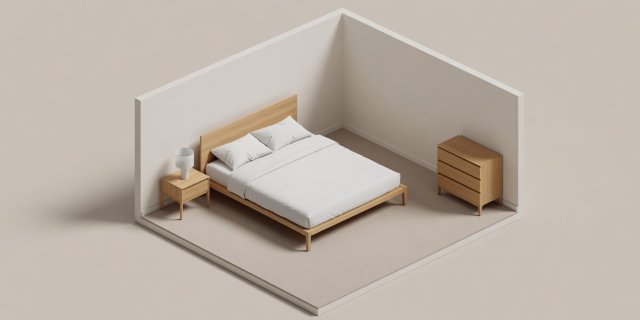
The Geometry of 60" × 80"
With a total surface area of 4,800 square inches (33.3 square feet), the Queen introduces two pivotal dimensions that separate it from smaller foundations:
- The 80-Inch Longitudinal Axis: Allows individuals up to 6'4" (193 cm) to stretch fully without their heels contacting the foot boundary or hanging into open air.
- The 60-Inch Transverse Axis: Grants 30 inches of dedicated personal width per co-sleeper. While narrower than a solitary Twin, 30 inches provides adequate clearance for lateral side-sleeping with knees bent.
Bedroom Proportions: 10'×10' vs 10'×12'
The viability of a Queen bed hinges entirely on the shape of the room envelope. Many builders market secondary bedrooms as "10 × 10 feet" master suites. When placed into a strict 10' × 10' box, a Queen foundation leaves only 40 inches of total lateral clearance (20 inches per side), violating the 30-inch architectural minimum.
| Room Size | Lateral Clearance (Each Side) | Foot of Bed Clearance | Ergonomic Rating |
|---|---|---|---|
| 10' × 10' (3.0 × 3.0 m) | 20 Inches (Choked) | 35 Inches (Adequate) | Restricted Circulation |
| 10' × 11' (3.0 × 3.3 m) | 26 Inches (Tight) | 42 Inches (Generous) | Acceptable with Compact Nightstands |
| 10' × 12' (3.0 × 3.6 m) | 30 Inches (Optimal) | 54 Inches (Spacious) | Golden Architectural Baseline |
| 12' × 14' (3.6 × 4.2 m) | 42 Inches (Expansive) | 78 Inches (Open) | Consider King Upgrade |
Nightstand Integration and Plug Clearances
A frequent architectural oversight when anchoring a Queen bed is flanking electrical and lighting fixtures. Standard residential nightstands range between 18 and 26 inches in width. On a 10-foot headboard wall (120 inches), a 60-inch Queen mattress leaves 60 inches of leftover wall span.
Divided evenly, that provides 30 inches on either side. Once a 24-inch nightstand is positioned, only 6 inches remain between the nightstand edge and adjacent walls or doorways. Any structural outlet positioned at the 28-inch mark becomes obscured behind the furniture facade, requiring recessed outlet adapters or cord relocators.
When Queen Becomes a Trap
If your room includes a swing closet door on one flank and an en-suite bathroom door on the opposite wall, a Queen bed frame can lock you into a tight squeeze. Measure door swing radiuses before committing: if a 32-inch door swings inward directly toward the mattress corner, you will be forced to modify door hardware or switch to a sliding barn door.
Exploring larger dimensions? Continue to our comprehensive breakdown of Eastern King vs California King or consult the Perimeter Walking Clearance Blueprint.