Twin to Full: Solo Spatial Limits
The jump from Twin to Full is rarely an issue of budget; it is a critical test of floor real estate. For single sleepers residing in urban micro-apartments, high-density studios, or historic homes with tight secondary bedrooms, every square foot allocated to sleep surface steals valuable circulation and workspace.
The Three Solo Formats Compared
Solo sleeping is not uniform. Human height, natural lateral rotation during REM cycles, and daily bedroom utility dictate which format makes architectural sense.
| Format | Dimensions | Surface | Minimum Room Size |
|---|---|---|---|
| Standard Twin | 38" × 75" (96.5 × 190.5 cm) | 19.8 sq ft | 7' × 9' (2.1 × 2.7 m) |
| Twin XL | 38" × 80" (96.5 × 203.0 cm) | 21.1 sq ft | 7' × 10' (2.1 × 3.0 m) |
| Full / Double | 54" × 75" (137.0 × 190.5 cm) | 28.1 sq ft | 9' × 10' (2.7 × 3.0 m) |
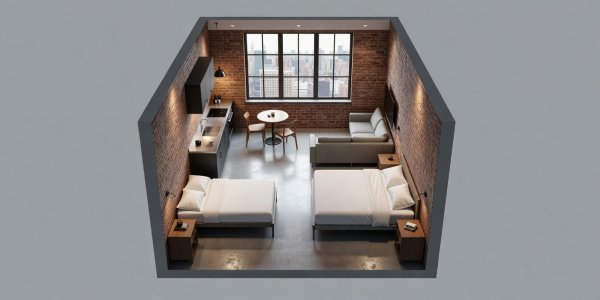
Standard Twin: The Ultra-Compact Enclave
At 38 inches wide by 75 inches long, a standard Twin is designed for tight perimeter positioning. Unlike Queen and King beds, which demand central placement with symmetrical flanking nightstands, a Twin is frequently docked directly into a corner wall. This eliminates one 30-inch perimeter walkway requirement, freeing approximately 16 square feet of functional floor area for a desk or wardrobe.
The Biomechanical Constraint: The 75-inch length (6 feet 3 inches) becomes restrictive for anyone over 5 feet 9 inches. Once pillows displace the top 10 inches, adult feet will hang over the mattress footboard.
Twin XL: The Tall Solo Ergonomic Standard
Twin XL adds 5 inches of longitudinal length (matching a standard Queen at 80 inches) while retaining the narrow 38-inch width. This represents the supreme compromise for tall adolescents, university dormitories, and slender guest rooms where vertical height matters far more than lateral sprawl. Two Twin XL beds placed side-by-side also construct the exact spatial footprint of an Eastern King (76" × 80"), making them ideal for adjustable split-frame bases.
Full / Double: The Solo Luxury vs Couple Compromise
Adding 16 inches of lateral width over a Twin, the 54" × 75" Full mattress transforms a solo sleeping environment into a restful expanse. A single adult can read comfortably, roll without edge anxiety, and accommodate a pet.
However, the Full mattress carries an unfortunate legacy moniker: the "Double". Historically treated as a two-person bed, in contemporary ergonomics it provides only 27 inches of width per person. While technically functional for guest bedrooms or short weekend stays, everyday co-sleeping on a Full induces chronic sleep disturbance due to motion transfer and restricted thermal ventilation.
Architectural Checklist: When to Choose Full over Twin XL
Choose a Full if your bedroom exceeds 9' × 10' and you are a solo sleeper under 6'0". Choose a Twin XL if the room is narrow (under 8 feet wide), you require a dedicated desk workstation in the same space, or your height exceeds 6'0".
Ready to test your exact room layout against standard clearance walkways? Visit our Bedroom Spatial Clearance Guide or check our Queen Size Evaluation.